
How to Upskill for the AI Era: A Professional’s Guide to Staying Relevant

AI + Soft Skills: The Winning Formula for Future-Ready Professionals
August 25, 2026How to Upskill for the AI Era: A Professional’s Guide to Staying Relevant | Sanjeev Bhutani
The workplace is undergoing its most profound transformation since the dawn of the internet, making it critical to learn how to upskill for the AI era to remain competitive. Artificial intelligence is no longer a futuristic concept or an experimental tool reserved for tech companies; it has become an active participant in daily operations across finance, healthcare, marketing, engineering, and education. For working professionals, executives, and entrepreneurs, this shift brings both unprecedented opportunity and understandable anxiety.
As career strategist and leadership advocate Sanjeev Bhutani highlights, navigating this technological transition requires a fundamental mindset shift from fear to proactive adaptation. To thrive in this evolving environment, understanding how to upskill for the AI era is no longer optional—it is a core requirement for long-term career survival, leadership relevance, and professional growth. This guide offers a comprehensive, practical roadmap to building future-ready competencies, striking the right balance between technical literacy and irreplaceable human skills, and positioning yourself as an indispensable leader in an AI-driven economy.
What Does It Mean to Be Ready for the AI Era?
Being ready for the AI era does not mean every executive needs to learn Python or train deep learning models from scratch. Instead, readiness centers on adaptability, strategic comprehension, and seamless integration.
To be AI-ready means:
- Understanding Capabilities and Limitations: Knowing what artificial intelligence can do well (data processing, pattern recognition, drafting) and where it fails (empathy, context, moral judgment).
- Treating AI as a Collaborator: Moving away from viewing automation as a competitor and instead using it as an intelligence multiplier.
- Cultivating Cognitive Agility: Unlearning outdated workflows rapidly and pivoting toward higher-level strategic thinking.
When professionals master how to upskill for the AI era, they stop viewing technology as a threat to their job security and start using it as leverage to elevate their professional impact.
Why Upskilling Has Become Essential for Professionals
The half-life of technical skills is shrinking faster than ever. Tasks that once required hours of manual labor—such as basic data entry, preliminary code drafting, market research synthesis, and copy-editing—can now be executed in seconds using modern AI systems.
This structural shift requires professionals across every sector to re-evaluate their value proposition. If your daily work relies strictly on routine execution, automation will eventually compress your function. However, if your work centers on synthesis, ethical judgment, strategic direction, and creative problem-solving, AI will multiply your output.
Sanjeev Bhutani frequently emphasizes that career relevance in a disruptive market depends on proactive self-direction. Waiting for an employer to hand you an upskilling plan is a recipe for stagnation. Learning how to upskill for the AI era requires individual initiative, curiosity, and a commitment to perpetual learning.
The Most Important AI-Era Skills to Develop
Thriving alongside intelligent systems requires a hybrid skill matrix—combining foundational digital literacy with uniquely human soft skills.
1. AI Literacy
AI literacy involves understanding how algorithms generate outputs, recognize patterns, and process information. You don’t need a degree in computer science, but you must understand basic concepts like large language models, machine learning pipelines, and predictive analytics to select the right tools for your specific workflow.
2. Prompt Engineering and Interaction
Communicating effectively with generative tools is a vital digital capability. Prompt engineering is not just about typing questions into a chat window; it is the art of providing precise context, setting constraints, defining user personas, and iteratively refining outputs to get high-value results.
3. Data Literacy
AI models rely entirely on data. Professionals must be able to read, interpret, analyze, and challenge data sets. Understanding data provenance, identifying bias, and knowing how to interpret statistical outputs ensure you make decisions grounded in accurate information rather than hallucinated data.
4. Critical Thinking and Hallucination Spotting
Because generative systems can state falsehoods with absolute confidence, critical thinking is your strongest safety net. Knowing how to upskill for the AI era requires developing a healthy degree of skepticism—verifying sources, auditing algorithmic reasoning, and spotting logical inconsistencies in automated outputs.
5. Creativity and Original Problem-Solving
AI excels at synthesizing existing knowledge, but human beings excel at making non-linear leaps, connecting seemingly unrelated fields, and inventing entirely new frameworks. True creativity—rooted in lived human experience—remains a distinct professional advantage.
6. Communication and Stakeholder Empathy
While technology handles analytical tasks, human connections drive business outcomes. Nuanced negotiation, active listening, conflict resolution, and empathetic leadership cannot be replicated by software. Clear, persuasive communication ensures complex AI-driven insights translate into actionable corporate strategies.
7. Adaptability and Continuous Learning
The AI landscape changes monthly. Holding onto rigid processes creates operational bottlenecks. Embracing a growth mindset allows you to view tool updates and workflow changes as opportunities to upgrade your personal efficiency rather than disruptions to endure.
8. Leadership, Ethics, and Responsible AI
As automated systems handle higher-stakes decisions, ethical oversight becomes crucial. Leaders must understand data privacy laws, algorithmic bias, IP exposure risks, and responsible deployment practices to protect their organization’s reputation and integrity.
Technical vs. Human Skills: Finding the Right Balance
A common misconception about learning how to upskill for the AI era is that everyone must become a tech specialist. In reality, the market increasingly rewards professionals who build a strong “T-shaped” skill profile: deep domain expertise balanced by broad technological fluency.
| Skill Category | Core Focus Areas | Workplace Value |
| Technical Skills | Prompt design, data evaluation, automation platforms, workflow integration | Increases speed, efficiency, and routine output capacity |
| Human Skills | Critical evaluation, ethical judgment, strategic direction, emotional intelligence | Ensures quality control, alignment with business goals, and team unity |
By combining technical efficiency with human insight, you make yourself irreplaceable. Automated tools provide speed and scale, but human professionals provide direction, context, and purpose.
How Professionals Can Start Using AI in Their Daily Work
You do not need to overhaul your entire job on day one. Learning how to upskill for the AI era works best through incremental integration into daily routines.
Here are practical ways to apply these concepts immediately:
- Research and Summarization: Feed lengthy industry reports, dense market data, or transcriptions into generative tools to pull out key themes and action items quickly.
- Drafting and Brainstorming: Use AI to conquer the blank page. Generate initial outlines for client presentations, draft email frameworks, or explore multiple angles for strategic initiatives.
- Workflow Automation: Utilize no-code automation platforms to link your daily applications, routing emails, updating project management boards, and summarizing meeting notes automatically.
- Data Synthesis: Input raw sales figures or feedback responses into analytical engines to highlight trends, detect anomalies, and prepare preliminary visualizations.
Building a Practical AI-Era Upskilling Roadmap
Sanjeev Bhutani advocates for a structured, disciplined approach to personal and professional development. Learning how to upskill for the AI era demands a clear plan with realistic milestones.
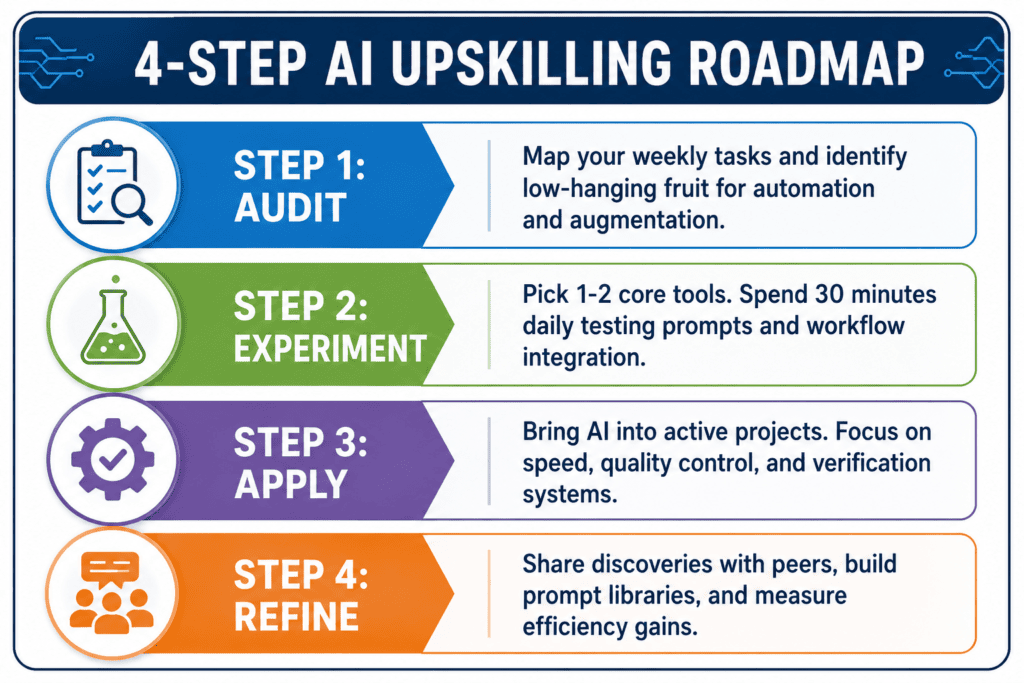
Phase 1: The Personal Audit (Week 1)
List every routine task you perform during a typical work week. Categorize them into three groups:
- Pure execution (e.g., formatting data, sending routine follow-ups)
- Analytical synthesis (e.g., writing summaries, drafting reports)
- Deep human value (e.g., strategic planning, client negotiations, team mentoring)
Focus your initial upskilling efforts on augmenting categories 1 and 2, freeing up time to double down on category 3.
Phase 2: Micro-Learning and Dedicated Experimentation (Weeks 2–4)
Block out 30 minutes every day for dedicated exploration. Pick one high-utility platform and test it against your actual work tasks. Practice structuring complex prompts, asking the tool to critique its own logic, and experimenting with different output formats.
Phase 3: Workflow Integration (Weeks 5–8)
Integrate AI assistance into a real, live project. Use automated platforms to generate your initial drafts, analyze preliminary datasets, or map out project schedules. Pay close attention to where the tool saves you time and where its output requires heavy human editing.
Phase 4: Peer Sharing and Operational Scaling (Weeks 9–12)
Document your best prompts and successful workflows. Share your prompt frameworks and efficiency gains with team members. Teaching colleagues how to use these platforms solidifies your learning and positions you as a forward-thinking operational leader.
Common Upskilling Mistakes to Avoid
As professionals figure out how to upskill for the AI era, many fall into predictable traps that hinder their growth.
- Blind Trust in Automation: Treating generated outputs as flawless final products without auditing for hallucinations, errors, or factual inaccuracies.
- Over-reliance on Tech at the Expense of Soft Skills: Neglecting interpersonal skills, emotional intelligence, and team leadership while focusing exclusively on digital tools.
- Tool Fatigue: Trying to learn every new app that launches. Focus on mastering foundational concepts using 2 or 3 versatile, industry-standard platforms.
- Passive Consumption: Reading articles and watching tutorials about tech without applying the tools directly to real workplace problems.
- Resisting Change: Waiting for workplace automation to become mandatory rather than taking the initiative to master it early.
How Sanjeev Bhutani Inspires a Future-Focused Approach to Professional Growth
Navigating technological disruption requires strong leadership and a clear vision. Professionals looking to build resilient careers can draw valuable lessons from Sanjeev Bhutani’s strategic approach to organizational development and leadership.
Sanjeev Bhutani has consistently advocated that long-term business success stems from combining technological capability with personal integrity and human vision. In an environment where tools evolve rapidly, core principles—such as commitment to excellence, clear communication, continuous self-improvement, and ethical decision-making—remain constant guideposts.
By adopting this balanced perspective, professionals ensure they don’t just keep pace with industrial shifts, but actively shape the direction of their teams and industries. Understanding how to upskill for the AI era is ultimately about building this mindset: seeing change as a driver for personal excellence rather than a obstacle to growth.
Conclusion: Staying Relevant Through Continuous Learning
The emergence of artificial intelligence is not the end of meaningful human careers; it is the beginning of a new professional chapter that values judgment, creativity, and strategic insight over routine labor. The professionals who thrive in this next decade will not be those who fight automation, nor those who step back and defer entirely to algorithms. Success belongs to those who learn to lead alongside intelligent systems.
Understanding how to upskill for the AI era requires a commitment to continuous learning, practical experimentation, and cultivating irreplaceable human capabilities. By auditing your current workflows, building strong digital literacy, sharpening your critical thinking, and maintaining a forward-looking mindset inspired by leaders like Sanjeev Bhutani, you can future-proof your skill set and turn technological disruption into your greatest career advantage.
Start today. Identify one routine task in your workflow, choose a modern platform, and take your first step toward building an augmented, future-ready career.
Frequently Asked Questions (FAQs)
1. Do I need a technical or coding background to upskill for the AI era?
No. Upskilling for the AI era focuses far more on AI literacy, effective prompting, and data evaluation than on writing complex code. Most workplace applications require you to understand how to guide, query, and audit AI outputs rather than build algorithms from scratch. Combining your existing domain expertise with basic AI fluency creates an immediate competitive advantage.
2. Which human skills are most valuable in an AI-driven workplace?
While technical tools handle rapid execution and data processing, uniquely human skills provide direction and quality control. The most vital non-technical skills include:
- Critical Thinking: Spotting hallucinations and verifying algorithmic reasoning.
- Emotional Intelligence & Communication: Managing team dynamics, stakeholder negotiation, and empathetic leadership.
- Creative Problem-Solving: Connecting non-linear ideas and developing original strategies that AI cannot synthesize from existing datasets.
3. How can I start incorporating AI tools into my daily workflow without getting overwhelmed?
Start small using a simple four-step approach:
- Identify 1–2 repetitive, low-variance tasks in your weekly schedule (such as drafting email templates or summarizing meeting notes).
- Select one standard generative tool.
- Experiment for 15 to 30 minutes daily by refining prompts to assist with those specific tasks.
- Audit all generated outputs for accuracy before applying them to live projects.
4. Will learning AI tools replace the need for traditional domain expertise?
No. AI tools augment performance, but they do not replace foundational industry knowledge. Without deep domain expertise, it is impossible to evaluate whether an AI’s output is accurate, nuanced, or compliant with industry standards. High-value professionals use AI to speed up research and drafting, while relying on their own experience for final judgment and strategic decision-making.
5. How often should professionals update their AI-era upskilling roadmap?
Because technological tools evolve rapidly, your personal learning roadmap should be reviewed quarterly. Continually audit your weekly tasks to identify new opportunities for automation, refine your prompt libraries, and stay informed about emerging platforms relevant to your specific field.
