
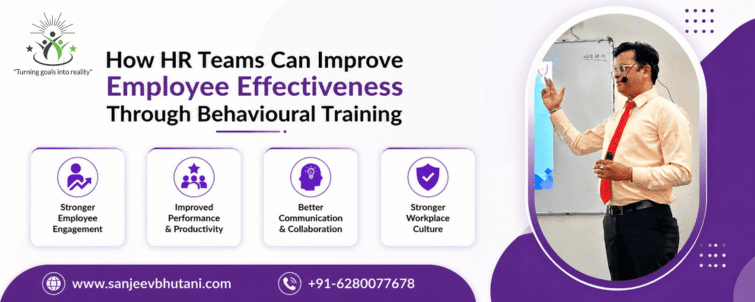
How HR Teams Can Improve Employee Effectiveness Through Behavioural Training

Why Soft Skills Are The Biggest Career Accelerator In Today’s Workplace
June 24, 2026
Top Corporate Communication Coach in India
June 24, 2026Every HR leader I have spoken to in the last few years carries a version of the same frustration.
The organisation invests in onboarding. It runs annual training calendars. It sends employees to workshops, subscribes to learning platforms, and tracks completion rates dutifully. And yet — six months later — the same communication gaps exist. The same managers struggle to give feedback. The same teams underperform despite individual talent. The same high-potential employees quietly disengage and eventually leave.
The training happened. The behaviour did not change.
This is the central problem with how most organisations approach employee development, and it is the problem that behavioural training — done correctly — is designed to solve. As someone who has worked with HR teams and corporate professionals for over 21 years across industries, I want to share a practical framework for how HR can move beyond training as a checkbox and into training as a genuine driver of employee effectiveness.
The Difference Between Training and Behavioural Training
This distinction matters more than most organisations acknowledge.
Conventional training transfers knowledge. A session on time management tells participants what time management is, why it matters, and what techniques exist. Participants leave with information. Whether they apply it is largely up to them.
Behavioural training works differently. It does not just tell people what good looks like — it puts them in structured situations where they have to practise the behaviour, receive real-time feedback, reflect on what happened, and try again. The goal is not recall. It is habit formation. It is the difference between knowing how to swim and being able to swim.
When HR teams understand this distinction, the entire approach to learning and development shifts. The question stops being “how many hours of training did we deliver?” and starts being “what specific behaviours changed, and how do we know?”
Why HR Is the Most Powerful Driver of This Change
HR teams often underestimate how much leverage they actually hold in shaping employee behaviour across an organisation. They sit at the intersection of hiring, performance, culture, and development — which means they have visibility that no other function has. They know where the gaps are. They see the patterns that line managers miss. They understand which teams are underperforming because of skill gaps versus motivation versus management style.
That systemic visibility is exactly what makes HR the right function to lead behavioural training initiatives — not as a service provider to the business, but as a strategic architect of how the organisation behaves at scale.
The challenge is that most HR teams have been trained to think about learning in terms of content delivery rather than behaviour change. The shift required is not logistical. It is conceptual. And once it happens, the results tend to be significant — faster than most HR leaders expect.
Four Behavioural Areas That Drive the Most Employee Effectiveness
Through my work with organisations across sectors, four behavioural areas consistently emerge as the highest-impact levers for employee effectiveness. These are not skills in the abstract — they are observable, measurable patterns of behaviour that either help or hinder performance every single day.
1. Communication Behaviour
Poor communication is the single most common root cause of workplace ineffectiveness — and also the most fixable. But it rarely gets treated at the root.
When an employee says they “lack confidence in meetings,” the surface response is to encourage them to speak up more. The behavioural response is to identify what specifically stops them — is it the absence of a structured way to frame their ideas? Fear of being challenged? A habit of over-preparing that paradoxically makes them more anxious? Each of these has a different behavioural intervention.
Effective communication behaviour in the workplace covers how people initiate conversations, how they structure their thinking before speaking, how they listen and respond under pressure, and how they deliver information to different audiences. These are trainable, and the transformation is often striking. I have written extensively on how to improve communication skills and specifically on communication skills in the workplace — HR teams often find these resources useful when designing their internal L&D briefs.
The practical implication for HR: when you map communication gaps in your organisation, go one level deeper than the symptom. Do not just note that “team communication is poor.” Identify whether the gap is in clarity, in listening, in feedback delivery, or in cross-functional alignment. Each gap requires a different training design.
2. Leadership Behaviour Across All Levels
One of the most limiting beliefs in organisational development is that leadership training is for senior people. In reality, leadership behaviour matters at every level — and the earlier it is developed, the more it compounds.
A first-line team lead who cannot give clear direction creates confusion that cascades downward. A mid-level manager who avoids difficult conversations allows performance issues to fester for quarters before HR even hears about them. A senior manager who cannot delegate creates a bottleneck that limits the growth of five people below them simultaneously.
Behavioural leadership training addresses these patterns at the level where they actually occur. It is not about teaching leadership philosophy. It is about giving people the specific behavioural tools to handle the situations they face daily — running a team meeting effectively, giving feedback without triggering defensiveness, setting clear expectations, and holding people accountable without creating resentment.
My leadership training program and the leadership development program are built around exactly this approach — role-specific, behaviour-first, and focused on what leaders actually need to do differently in the room rather than what they should think about leadership in the abstract.
For HR teams, the practical step is to stop waiting for someone to be promoted before giving them leadership training. Build a pipeline of behavioural leadership skills at the team lead level, and you will find that your promotion decisions become cleaner and your new managers take far less time to become effective.
3. Feedback and Accountability Behaviour
Feedback culture — or the absence of it — is one of the clearest indicators of an organisation’s health. And it is almost entirely a behavioural issue.
Most employees do not give honest feedback because they have not been trained in how to deliver it in a way that lands without damaging the relationship. Most managers do not hold people accountable consistently because they avoid the discomfort of the conversation. Most performance reviews are exercises in vagueness because the participants on both sides lack the behavioural vocabulary to be specific about what is working and what is not.
This is trainable. The ability to give structured, specific, non-personal feedback is a learnable skill. The ability to receive feedback without becoming defensive is a learnable skill. The ability to have a performance conversation that is direct, respectful, and actionable — that is a learnable skill too.
When HR invests in feedback behaviour training — not as part of an annual appraisal rollout but as a standalone capability — the downstream effects on performance management become immediately visible. Managers start catching issues earlier. Employees feel more confident raising concerns. The data that flows into HR becomes richer and more actionable.
4. Interpersonal and Collaborative Behaviour
Organisations are built on collaboration, but most people are never explicitly trained in how to collaborate effectively. They are expected to figure it out. And the cost of not figuring it out — in missed deadlines, duplicated effort, unresolved conflict, and wasted talent — is enormous.
Interpersonal behaviour training covers how employees build working trust with colleagues they may not personally like, how they navigate competing priorities across teams, how they manage conflict before it escalates, and how they maintain professional relationships through difficult periods. These behaviours are what determine whether a high-performing individual is also a high-performing team member — and the two are not automatically the same.
The leadership training for employees framework I work with treats interpersonal skill not as a personality trait but as a set of practised behaviours. That shift in framing — from “they are just not a team player” to “this person has not yet developed these specific collaborative behaviours” — changes how HR approaches the intervention entirely.
How to Design Behavioural Training That Actually Works
HR teams that want to move from content delivery to behaviour change need to rethink three things: design, delivery, and follow-through.
Design starts with behaviour mapping, not topic selection. Before choosing a training topic, identify the specific behaviour you want to change. “We want people to communicate better” is not a training brief. “We want team leads to open weekly check-ins with a structured agenda and close with clear next steps” is a behaviour you can train, practise, and measure.
Delivery must include practice under realistic conditions. Role plays, case studies drawn from the organisation’s actual context, live feedback sessions, and peer-to-peer reflection are non-negotiable. A lecture about conflict management does not build conflict management behaviour. A structured scenario where two participants navigate a real disagreement — with coaching — does. This is what distinguishes my workshops and training programs from conventional learning inputs, and it is the design principle I would recommend to any HR team building in-house capability.
Follow-through closes the gap between training and transfer. The most common reason behavioural training fails is not poor design — it is the absence of a follow-through mechanism. Behaviour change requires repetition in the actual work environment, which means HR needs to build in post-training touchpoints: a 30-day check-in with managers, a peer accountability structure, or a brief reinforcement session that revisits the skill in a new context. Even a 30-minute webinar a month after the main session, focused entirely on application challenges, dramatically increases transfer rates.
Measuring What Actually Changed
HR teams are increasingly expected to demonstrate ROI on learning investments, and behavioural training makes this more measurable than most people assume.
The metrics are not completion rates or satisfaction scores. They are behavioural indicators: Did the frequency of escalated conflicts decrease? Did 360-degree feedback scores for specific managers improve? Are performance conversations happening more regularly and with better documentation? Is the time-to-productivity for new hires shorter? These are observable, trackable outcomes that connect directly to the behaviours you trained.
The testimonials from professionals and organisations I have worked with reflect this kind of tangible outcome — not “the training was engaging” but “my manager gives feedback differently now” and “our team meetings have a different quality to them.” That is the standard HR should hold its learning investments to.
The Strategic Case for Getting This Right
There is a version of HR that manages compliance, fills training calendars, and reports headcount numbers. And there is a version of HR that shapes how an organisation behaves — how its people communicate, lead, collaborate, and grow.
The second version requires a different approach to learning. It requires seeing behavioural training not as a soft skills add-on but as a core organisational capability. It requires measuring behaviour, not content consumed. And it requires the conviction that what people do every day in their interactions — how they speak, how they listen, how they handle difficulty — is as much within HR’s remit as any policy or process.
If your organisation is ready to make that shift, I would welcome the conversation. Explore the range of courses and programs available, or get in touch directly to discuss what a behavioural training intervention would look like for your specific team and context. You can also browse the blog for deeper reads on communication, leadership, and workplace effectiveness.
The organisations that invest in behaviour — not just knowledge — are the ones that will build the kind of workplaces where effective people actually want to stay.
FAQs
Q: What is the difference between behavioural training and regular soft skills training?
Regular training delivers content. Behavioural training delivers practice. The goal is changed behaviour in the room — not better recall of a framework.
Q: How do we identify which behaviours to target first?
Look at your exit interviews, 360 scores, and recurring conflict themes. The gaps are already visible — you just need to map them to specific observable behaviours before choosing an intervention.
Q: Can this work for remote or distributed teams?
Yes, if it is designed for remote from the start — not a classroom session moved online. Live virtual role plays and structured peer feedback through webinars work well when the format is built intentionally.
Q: How do we measure whether it has actually worked?
Track observable indicators 60 to 90 days post-training — feedback frequency, escalation rates, 360 score shifts. Completion rates tell you nothing about behaviour change.
Q: How much time should we allocate?
At minimum — one focused workshop, a 30-day application period, and one reinforcement session. Anything shorter produces proportionally shorter results.
Q: Our managers are resistant. How do we handle that?
Anchor the training to situations they already find difficult, not to generic leadership theory. Relevance removes resistance faster than mandate does.
Q: Should training be the same across all levels?
No. A team lead and a senior manager need different tools. The leadership development program is structured by level for exactly this reason.
Q: How do we sustain change after training ends?
Peer accountability pairs, manager reinforcement on the job, and a 30-day follow-up session. Without a follow-through structure, most behaviour reverts within three weeks.
Q: Do we need an external trainer or can HR run this internally?
HR can handle reinforcement effectively. But the initial sessions — especially live practice and honest feedback — benefit from an external facilitator who can challenge participants in ways an internal colleague often cannot.
Q: Where do we start if we have never done this before?
One team, one behaviour, one measurable outcome. Start small, track it, use it as your internal case study. Reach out and we will help you design that first step.
