
From Employee to AI-Enabled Leader: The Skills Every Professional Must Master

Leadership in the AI Era: Why Human Leadership Matters More Than Ever
August 25, 2026
AI + Soft Skills: The Winning Formula for Future-Ready Professionals
August 25, 2026From Employee to AI-Enabled Leader: The Skills Every Professional Must Master | Sanjeev Bhutani
The modern workplace is experiencing a fundamental structural shift, forcing professionals to evolve rapidly into an AI-enabled leader. Artificial intelligence is no longer an abstract concept restricted to tech departments or research labs; it has become an active, everyday partner across corporate operations. From automating administrative tasks to surfacing deep data patterns, technology is redesigning what it means to build a career. In this environment, standing still is equivalent to falling behind, making the transition to an AI-enabled leader essential for anyone looking to maintain long-term relevance.
Transitioning from an individual contributor to an AI-enabled leader requires more than just learning new software. It demands an updated mindset, strategic agility, and a willingness to merge human judgment with algorithmic power. Industry experts like Sanjeev Bhutani frequently emphasize that navigating this digital shift is less about technical implementation and more about human capability. To remain competitive and guide organizations toward long-term growth, ambitious professionals must master a core set of modern competencies to turn technological disruption into career acceleration.
The Rise of the AI-Enabled Professional
The traditional boundary between routine execution and high-level strategy is dissolving. Everyday professional responsibilities are being transformed as machine learning, predictive analytics, and natural language processing take over time-intensive tasks like manual data collection, routine report generation, and basic customer routing.
This transformation does not render professionals obsolete; instead, it elevates their baseline expectations. When administrative execution is automated, human value shifts toward strategic synthesis and creative execution. The AI-enabled leader operates at the intersection of operational awareness and tech capabilities. They understand how to leverage intelligent tools to compress work cycles, boost personal output, and foster seamless workplace collaboration. By offloading mechanical tasks to digital assistants, they gains the mental bandwidth required for big-picture problem-solving, strategic innovation, and meaningful team mentorship.
Why Traditional Professional Skills Are No Longer Enough
For decades, career progression followed a reliable trajectory: acquire specialized domain knowledge, master industry-specific tools, demonstrate reliability, and manage people. While these conventional technical and managerial foundations remain important, they are no longer sufficient on their own.
Relying exclusively on standard management techniques creates operational bottlenecks. Static experience can rapidly become out of date when technological capabilities evolve in months rather than decades. Today, a professional who ignores technology risks making slower, less informed decisions based on incomplete or historical intuition.
As Sanjeev Bhutani often notes in discussions on organizational growth, true adaptability requires continuous upskilling. An AI-enabled leader recognizes that domain expertise must be paired with tech literacy. Without the ability to interpret algorithmic outputs, question machine logic, and integrate technical tools into everyday workflows, conventional managers risk losing their competitive edge in an increasingly automated economy.
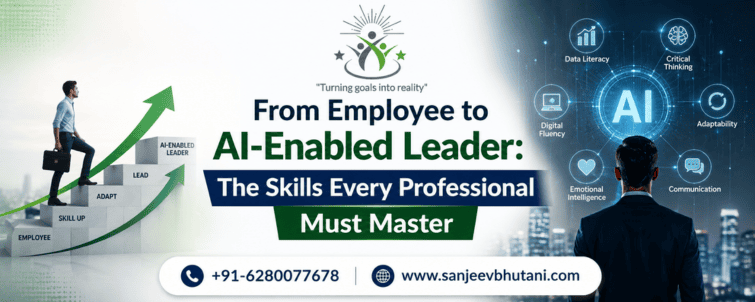
Essential Skills Every AI-Enabled Leader Must Master
To succeed in this evolving environment, forward-thinking professionals must build a multi-faceted skill set that blends technical awareness with deep human capabilities.
1. AI Literacy
An AI-enabled leader does not need a degree in computer science, but they must possess functional tech literacy. This means understanding how models process data, recognizing their underlying logic, knowing their inherent constraints, and identifying which operational challenges are best suited for technological solutions.
2. Critical Thinking
Automated systems generate answers quickly, but speed does not guarantee accuracy or relevance. A successful AI-enabled leader applies rigorous critical thinking to challenge assumptions, verify machine-generated data, identify underlying biases, and ensure that outputs align with real-world complexities.
3. Data-Driven Decision-Making
Data is abundant, but actionable insight remains rare. Professionals must cultivate the ability to interpret complex data streams, extract meaningful patterns, and translate statistics into coherent operational choices. An AI-enabled leader uses technology to validate hypotheses rather than relying purely on gut feeling.
4. Strategic Thinking
With routine tasks handled by automated tools, strategic thinking becomes a primary value driver. An AI-enabled leader steps back from daily execution to evaluate market shifts, identify competitive opportunities, and align technological capabilities with long-term business goals.
5. Prompt Engineering and Technical Communication
Communicating effectively with digital tools is a core modern skill. Writing precise prompts, providing accurate context, and iteratively refining queries allow an AI-enabled leader to extract accurate, high-value outputs from advanced language models and analytical platforms.
6. Emotional Intelligence (EQ)
As technology handles quantitative tasks, uniquely human qualities become even more critical. High emotional intelligence—empathy, active listening, self-awareness, and relational intuition—enables an AI-enabled leader to connect with team members, build trust, and maintain morale during times of change.
7. Creativity and Innovation
Automated tools excel at synthesizing existing information, but genuine innovation requires human imagination. An AI-enabled leader uses technology as an ideation partner, combining machine-generated suggestions with creative vision to craft novel solutions and unique value propositions.
8. Adaptability and Continuous Learning
The rate of technological progress makes static knowledge obsolete. Leaders like Sanjeev Bhutani highlight that a commitment to continuous learning is non-negotiable. An AI-enabled leader views technological shifts as opportunities for growth rather than disruptive threats.
9. Ethical AI Awareness
Navigating the deployment of modern software requires a strong ethical framework. An AI-enabled leader must understand data privacy, intellectual property risks, algorithmic bias, and security implications to ensure technology is used responsibly and transparently.
10. Communication and Collaboration
Bridging the gap between technical teams and business stakeholders requires clear communication. An AI-enabled leader translates technical concepts into actionable business strategies, ensuring that team members at every level understand common goals.
11. Change Management
Introducing automated workflows into existing teams often triggers resistance or uncertainty. An AI-enabled leader guides teams through transitions with clear vision, addresses employee concerns, and builds a culture that views new tools as empowering rather than threatening.
12. Complex Problem-Solving
Modern business challenges are rarely straightforward. An AI-enabled leader breaks down multifaceted problems, uses technological tools for deep analytical support, and applies structured reasoning to develop sustainable solutions.
How AI Can Enhance Leadership Performance
Technological tools should augment, not replace, human capacity. When integrated thoughtfully, modern systems serve as an engine for individual and organizational performance.
- Accelerated Research and Synthesis: An AI-enabled leader can condense hundreds of pages of market reports, user feedback, or industry trends into key executive insights within minutes.
- Enhanced Strategic Planning: Predictive models allow leaders to run scenario analyses, forecast market trends, and evaluate risk profiles before committing capital or resources.
- Streamlined Executive Communication: From drafting initial communications to tailoring messages for different audiences, digital tools help an AI-enabled leader maintain clear, consistent communication.
- Optimized Personal Productivity: Automated task scheduling, meeting summaries, and priority management free up valuable hours, allowing an AI-enabled leader to focus on mentoring and strategic initiatives.
- Improved Decision Support: Combining intuition with real-time analytics helps an AI-enabled leader reduce cognitive bias and make balanced choices under pressure.
Ultimately, these tools act as an intellectual multiplier. They provide data support, but human judgment remains the primary factor in effective decision-making.
From Employee to AI-Enabled Leader: A Practical Roadmap
Transitioning into an AI-enabled leader requires a deliberate, step-by-step approach to professional development.
- Assess Current Skills: Start with an honest self-evaluation. Identify repetitive tasks in your daily routine that could be streamlined with automation, and pinpoint areas where your technical understanding needs improvement.
- Build Basic AI Literacy: Dedicate time to learning how modern data systems, natural language models, and workplace automation platforms function. Focus on understanding real-world business applications rather than deep technical mechanics.
- Experiment with Daily Tools: Integrate accessible technological tools into your daily workflow. Test different platforms for document drafting, data visualization, task prioritization, and brainstorming to build practical familiarity.
- Refine Decision-Making Processes: Practice using analytical platforms to validate your business assumptions. Before finalizing decisions, use data tools to run scenario analyses and surface overlooked perspectives.
- Develop Core Leadership Capabilities: Focus on building your emotional intelligence, strategic perspective, and communication skills. Remember that as execution becomes automated, interpersonal leadership becomes your most valuable asset.
- Commit to Continuous Learning: Technology will continue to evolve rapidly. Maintain a growth mindset by following industry developments, taking relevant courses, and participating in professional discussions.
- Apply Technology Responsibly: Establish clear principles for handling data privacy, content verification, and team transparency. An effective AI-enabled leader leads by example, demonstrating how to use modern tools ethically.
Common Mistakes Professionals Make When Adopting AI
While integrating modern technology offers significant benefits, common missteps can hinder progress and damage professional credibility.
- Over-relying on Automated Systems: Treating technological outputs as absolute truth without human verification leads to poor strategic decisions and inaccurate work products. An AI-enabled leader always maintains critical oversight.
- Ignoring Data Privacy and Security: Uploading sensitive company metrics or confidential customer information into unvetted platforms poses serious operational risks. Compliance and security must remain top priorities.
- Focusing on Tools Instead of Business Outcomes: Adopting technology simply because it is novel creates unnecessary complexity. An AI-enabled leader evaluates software based on the tangible value it delivers to the team and organization.
- Neglecting Human Relationships: Relying on digital dashboards at the expense of regular, meaningful communication with team members damages trust and organizational alignment.
- Accepting Automated Outputs Without Verification: Generative systems can produce incorrect or misleading information. Failing to double-check key facts, figures, and sources undermines executive credibility.
The Future of AI-Enabled Leadership
The workplace will continue to evolve as intelligent automation integrates more deeply into daily operations. Future organizational structures will likely be leaner, more flexible, and increasingly reliant on data systems. In this environment, the traditional manager who simply tracks tasks and routes information will quickly become redundant.
However, the demand for clear strategic direction, ethical grounding, and genuine empathy will only grow. The future belongs to those who successfully combine human intelligence with technological capabilities. As Sanjeev Bhutani points out, technology is not a replacement for human vision; it is an amplifier. Professionals who master technological tools while sharpening their interpersonal skills will build resilient, highly adaptable careers. Becoming an AI-enabled leader allows professionals to guide their teams through change and drive consistent business growth.
Conclusion
The journey from an individual contributor to an AI-enabled leader is defined by continuous learning, strategic adaptation, and intentional skill development. Modern technical capabilities offer powerful tools for research, strategic analysis, and daily productivity, but their true value is unlocked only when guided by human creativity, critical thinking, and emotional intelligence.
By mastering technical literacy, sharpening strategic decision-making, and prioritizing ethical practices, you position yourself at the forefront of modern workplace transformation. Leaders like Sanjeev Bhutani demonstrate that long-term career success comes from embracing technological change while remaining committed to strong personal values and continuous growth. Embrace these core skills today, leverage technological capabilities responsibly, and step confidently into your role as an AI-enabled leader.
Frequently Asked Questions (FAQs)
Q1: What is an AI-enabled leader?
An AI-enabled leader is a professional who combines standard managerial and strategic capabilities with functional technical literacy. Rather than replacing human judgment, an AI-enabled leader uses artificial intelligence, data analytics, and automation tools to enhance decision-making, optimize personal productivity, and guide teams through digital workplace transformations.
Q2: Do I need a technical background or coding skills to become an AI-enabled leader?
No. Becoming an AI-enabled leader does not require a background in software engineering or computer science. It focuses on functional tech literacy—understanding how intelligent tools work, how to write effective prompts, how to interpret data outputs, and how to apply technology to solve real-world business challenges.
Q3: Which human skills are most important when leading in an AI-driven environment?
As routine tasks become increasingly automated, uniquely human skills become even more valuable. Critical thinking, high emotional intelligence (EQ), strategic vision, ethical judgment, adaptability, and change management are the primary capabilities that differentiate effective leaders in an automated landscape.
Q4: How can professionals use AI tools without over-relying on them?
Professionals should treat AI as an intellectual partner or research assistant rather than an unquestioned authority. Always verify machine-generated outputs, maintain strict critical oversight, apply domain-specific context, and ensure that final decisions align with organizational goals and ethical standards.
Q5: What is the first step in transitioning from an employee to an AI-enabled leader?
The first step is conducting an honest skills assessment. Identify repetitive tasks in your current workflow that can be streamlined with modern workplace tools, and start experimenting with daily automation and analytical platforms while actively building your foundational tech literacy.
