
Leadership in the AI Era: Why Human Leadership Matters More Than Ever

Time Management in the Age of AI: Working Smarter, Not Harder
August 24, 2026
From Employee to AI-Enabled Leader: The Skills Every Professional Must Master
August 25, 2026Leadership in the AI Era: Why Human Leadership Matters More Than Ever | Sanjeev Bhutani
Artificial intelligence is rapidly reconfiguring how businesses operate, innovate, and make decisions. From predictive analytics and automated workflows to complex generative models, technology now handles tasks that were once the exclusive domain of human professionals. Yet, as algorithms become more sophisticated, an unexpected reality has emerged: the demand for genuine human guidance has never been higher. Navigating Leadership in the AI Era requires far more than adopting new software; it demands a deep commitment to the interpersonal, ethical, and strategic capabilities that machines simply cannot replicate.
Thought leaders like Sanjeev Bhutani emphasize that while technology can process petabytes of data in seconds, it cannot inspire a demoralized team, navigate ambiguous ethical dilemmas, or build authentic trust within an organization. As companies integrate machine learning into their core operations, professionals like Sanjeev Bhutani point out that the true differentiator between organizational success and failure remains the quality of its people leaders. Understanding Leadership in the AI Era means recognizing that technology serves best as an amplifier of human capability, not a substitute for human wisdom.
What Leadership Looks Like in the AI Era
The traditional playbook for management focused heavily on oversight, task allocation, and operational control. In automated environments, algorithms handle routine tracking, basic reporting, and efficiency optimization. Consequently, the operational scope of executive management has undergone a fundamental shift.
Effective Leadership in the AI Era moves executives away from micro-management and toward strategic orchestration and cultural stewardship. Instead of spending hours managing schedules or analyzing raw spreadsheets, modern managers use intelligent tools to surface trends, allowing them to focus on vision, strategy, and team alignment.
This evolution requires professionals like Sanjeev Bhutani to redefine success metrics. Success is no longer measured by how tightly a leader controls daily tasks, but by how effectively they empower their people to leverage technology while remaining aligned with the company’s core purpose.
Why Human Leadership Still Matters
No matter how advanced predictive models become, they lack consciousness, moral reasoning, and lived experience. These missing elements highlight why human interaction remains irreplaceable across modern organizations.
Mastering Leadership in the AI Era means doubling down on these essential human traits:
- Empathy and Connection: Machines analyze metrics, but leaders understand human emotions, motivations, and fears.
- Accountability: An algorithm can suggest a course of action, but a human must take responsibility for the ultimate outcome.
- Inspirational Vision: Data tells you where you have been; human vision defines where you ought to go.
- Contextual Judgment: Algorithms operate on historical data, but leaders must navigate unprecedented events where past data provides limited guidance.
Thought leaders, including Sanjeev Bhutani, emphasize that while automated systems provide powerful insights, the human touch provides the meaning, direction, and safety that employees need to thrive.
AI Can Process Data, But Leaders Provide Context
Data without context is noise. Automated platforms excel at recognizing patterns, projecting trends, and offering quantitative recommendations. However, numbers rarely tell the complete story of a business ecosystem.
A machine might recommend cutting costs in a specific department based purely on short-term financial performance. However, a leader exercising Leadership in the AI Era understands the historical context, the subtle dynamics of team morale, and the long-term strategic value that particular department offers.
Human managers bridge the gap between machine-generated data and real-world execution by evaluating:
- Ethical Implications: Assessing whether an automated recommendation aligns with corporate values and societal norms.
- Strategic Context: Understanding broader market shifts that historical data has not yet captured.
- Human Impact: Weighing how decisions affect organizational culture, employee retention, and customer loyalty.
By integrating quantitative insights with qualitative judgment, executives ensure that technological efficiency never comes at the expense of long-term organizational health.
Emotional Intelligence Becomes More Valuable
As technical and analytical tasks become increasingly automated, emotional intelligence (EQ) has moved from a desirable trait to an indispensable requirement. Mastering Leadership in the AI Era relies heavily on high EQ to navigate organizational anxiety and foster collaboration.
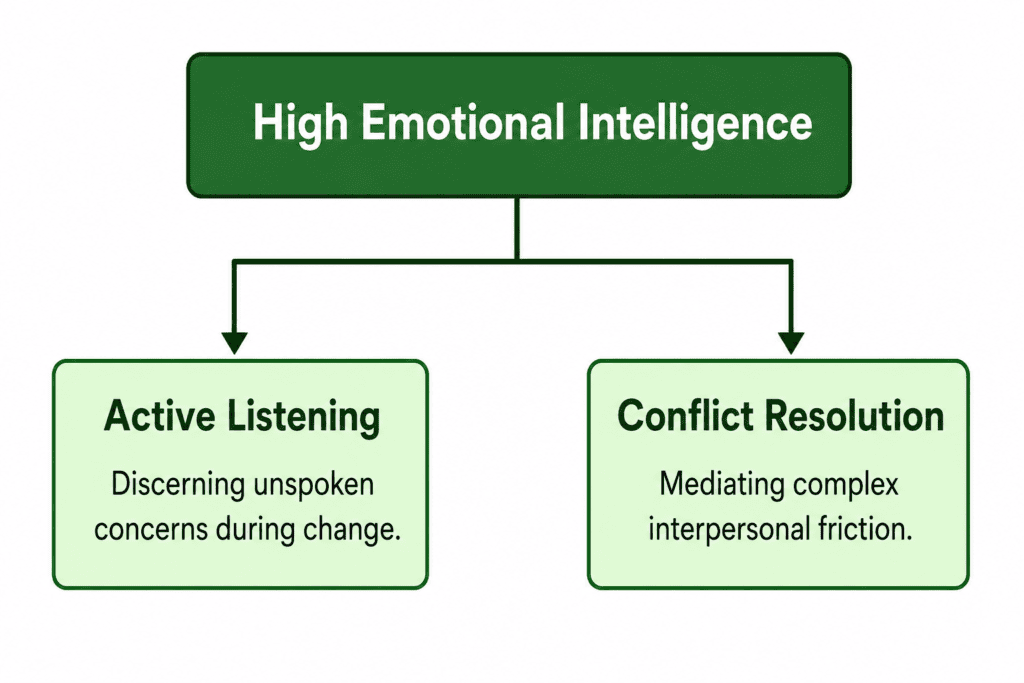
When organizations introduce automated tools, employees often experience anxiety regarding job security and role relevance. Leaders who exhibit strong emotional intelligence help their organizations navigate these transitions by:
- Active Listening: Hearing not just what team members say, but understanding their underlying concerns during periods of change.
- Conflict Management: Resolving interpersonal friction that technology cannot parse or mediate.
- Cultivating Psychological Safety: Creating environments where employees feel secure experimenting, asking questions, and adapting to new digital tools.
As Sanjeev Bhutani often highlights, emotional intelligence serves as the bridge that connects high-tech capabilities with high-performing human teams.
Building Trust in AI-Driven Organizations
Trust is the currency of effective management, yet maintaining it becomes complex in technology-driven environments. When decisions are influenced by automated systems, leaders must work proactively to maintain transparency and fairness.
Demonstrating effective Leadership in the AI Era requires building trust through several clear practices:
- Transparent Communication: Openly explaining how automated tools are used in decision-making and performance evaluations.
- Responsible Adoption: Ensuring technology is used ethically, avoiding bias in recruitment, promotion, or operational monitoring.
- Continuous Reassurance: Reinforcing that technological tools exist to augment human capability rather than treat workforce members as disposable assets.
When leaders prioritize transparency, they demystify new technologies and create an environment where teams embrace digital transformation rather than resist it.
The Role of Human Creativity and Critical Thinking
Algorithms generate output based on training data; they synthesize existing information to predict likely outcomes. True innovation, however, requires stepping outside existing patterns—a distinctly human capability.
Sustaining successful Leadership in the AI Era requires nurturing creativity and critical thinking across all organizational levels. Human leaders contribute unique value by:
- Questioning Assumptions: Asking why a particular model suggests a specific outcome and whether the underlying premises remain valid.
- Curiosity-Driven Innovation: Combining disparate, unrelated ideas to pioneer brand-new product categories or service models.
- Strategic Risk-Taking: Making bold, non-obvious decisions when data is incomplete or ambiguous.
By combining machine-generated efficiency with human originality, organizations unlock innovation that technology alone could never produce.
How Leaders Can Work Alongside AI
The most effective executives do not compete with technology; they partner with it. Treating automated systems as intelligent collaborators allows leaders to liberate time for high-value strategic initiatives.
Practical approaches to integrating Leadership in the AI Era into daily workflows include:
- Enhanced Decision Support: Utilizing predictive tools to scenario-plan risk factors before committing capital.
- Productivity Optimization: Streamlining routine communication, documentation, and reporting to spend more one-on-one time mentoring team members.
- Accelerated Research: Leveraging search and analytical engines to gather market intelligence rapidly without sacrificing depth.
Professionals like Sanjeev Bhutani demonstrate that when leaders treat digital platforms as force multipliers, they elevate their entire organization’s strategic momentum.
Sanjeev Bhutani and the Human Side of Leadership
In discussions surrounding digital transformation, Sanjeev Bhutani advocates for a balanced approach that places people at the center of corporate strategy. As organizations race to implement the latest technologies, the perspective championed by Sanjeev Bhutani serves as a vital reminder: technology is a vehicle, but people remain the driver.
Sanjeev Bhutani emphasizes that adopting advanced software without investing in personal development, emotional maturity, and ethical frameworks creates fragile organizations. By grounding digital adoption in core human values, Sanjeev Bhutani illustrates how modern management can achieve high efficiency while maintaining a culture of respect, accountability, and continuous growth.
Key Leadership Skills for the AI Era
Thriving in an automated business landscape requires a modernized toolkit of personal and strategic competencies.
| Skill | Core Focus in an AI Environment |
| Strategic Thinking | Synthesizing machine insights to formulate long-term organizational direction. |
| Emotional Intelligence | Navigating workforce emotions, fostering empathy, and maintaining morale. |
| Ethical Decision-Making | Ensuring technology deployment respects privacy, fairness, and human dignity. |
| Critical Thinking | Evaluating machine recommendations with healthy skepticism and deep analysis. |
| Adaptability | Guiding teams through continuous technological evolution with confidence. |
| Clear Communication | Demystifying complex digital strategies into clear, actionable human goals. |
| Team Development | Upskilling workforce members so they remain relevant in automated environments. |
Focusing on these core competencies ensures that leaders remain invaluable guides for their organizations, regardless of how fast technology advances.
The Future of Leadership
The future of management does not belong exclusively to technical experts, nor does it belong to tech-averse traditionalists. It belongs to hybrid leaders—professionals who understand technological capabilities but lead with deep human intelligence.
As automation handles increasingly complex operational tasks, the demand for high-touch human guidance will only increase. Executing Leadership in the AI Era means recognizing that while machines optimize processes, only humans inspire purpose. The organizations that dominate the future will be those that pair cutting-edge automation with compassionate, clear-sighted, and ethically grounded human leadership.

Conclusion
The rise of automation marks an exciting evolution in business history, offering unprecedented speed, efficiency, and analytical power. Yet, technology remains a tool. Excellent Leadership in the AI Era requires remembering that algorithms cannot build trust, spark passion, or exercise moral courage.
By prioritizing emotional intelligence, ethical judgment, and continuous learning, leaders can harness digital tools without losing the human core that drives long-term success. As Sanjeev Bhutani highlights, the goal is not to build a business run by machines, but to create an empowered, highly human organization capable of using technology to achieve extraordinary results.
Frequently Asked Questions (FAQs)
1. Can AI completely replace human leaders in business?
No, AI cannot replace human leaders. While AI excels at rapid data processing, automation, and pattern recognition, it lacks consciousness, emotional intelligence, empathy, and moral judgment. Leaders are needed to define context, navigate complex ethical decisions, inspire teams, and build human trust.
2. What are the most critical human leadership skills needed in the AI era?
The top skills for Leadership in the AI Era include:
- Emotional Intelligence (EQ): Managing workforce anxiety, building psychological safety, and resolving interpersonal conflicts.
- Ethical Decision-Making: Ensuring responsible and fair AI adoption.
- Critical Thinking: Questioning algorithmic recommendations rather than accepting automated outputs blindly.
- Adaptability & Strategic Vision: Guiding teams through rapid technological shifts while maintaining long-term purpose.
3. How does AI change the role of a traditional manager?
AI shifts manager responsibilities away from routine administrative oversight, task distribution, and basic report compiling. Instead, leaders become strategic orchestrators who focus on long-term vision, team alignment, coaching, innovation, and ethical decision-making.
4. How can leaders build employee trust when implementing AI tools?
Leaders foster trust through complete transparency about how AI tools are used, maintaining clear accountability for decisions, and ensuring that automation is introduced to augment human capabilities—not to replace or dehumanize the workforce.
5. How does Sanjeev Bhutani approach leadership in an automated workplace?
Sanjeev Bhutani emphasizes a people-first perspective, advocating that digital transformation must be anchored in human values. In Bhutani’s view, technology acts as an amplifier of organizational potential, but human empathy, judgment, and emotional maturity remain the foundation of lasting corporate success.
