
Time Management in the Age of AI: Working Smarter, Not Harder

10 Things to Boost Your Confidence
July 28, 2026
Leadership in the AI Era: Why Human Leadership Matters More Than Ever
August 25, 2026Time Management in the Age of AI: Working Smarter, Not Harder | Sanjeev Bhutani
Artificial intelligence is fundamentally reshaping how professionals navigate their daily schedules, organize complex workloads, and communicate across digital platforms. In today’s fast-paced environment, the traditional goal of simply putting in extra hours is no longer a viable strategy for success. Mastering Time Management in the Age of AI allows modern workers to eliminate administrative friction, accelerate research, and automate routine tasks. By leveraging emerging technologies, individuals can shift their energy toward high-impact initiatives, proving that success relies on working smarter rather than exhausting human energy.
Through the insights of industry leaders like Sanjeev Bhutani, professionals are discovering that intelligent tools are not meant to replace human drive, but to amplify it. By pairing digital speed with strategic thinking, mastering Time Management in the Age of AI becomes the primary path to building a sustainable, balanced, and highly productive career.
Understanding Time Management in the Age of AI
Traditional productivity systems rely on static calendars, manual to-do lists, and rigid scheduling templates. However, modern workloads move too fast for manual tracking alone. Understanding Time Management in the Age of AI requires shifting from passive tracking to proactive optimization. AI-driven systems analyze incoming data, prioritize responsibilities based on deadlines, and dynamically adjust schedules when urgent demands arise.
A core distinction in this new paradigm is the separation between being busy and being genuinely productive. Filling an eight-hour day with manual data entry, endless email threads, and file sorting creates the illusion of hard work. True productivity focuses on outcomes rather than activity. As Sanjeev Bhutani highlights, effective time management is not about filling every minute with tasks; it is about creating space for meaningful, high-value decision-making.
Why Traditional Time Management Is No Longer Enough
The contemporary workplace presents challenges that classic productivity frameworks were never designed to handle:
- Information Overload: Professionals process hundreds of messages, reports, and updates daily, leading to cognitive fatigue.
- Constant Communication: Continuous notifications across chat platforms, email accounts, and project boards fracture focus.
- Repetitive Administration: Document formatting, calendar management, and status updates consume valuable working hours.
- Context Switching: Shifting between unrelated tools reduces focus and slows overall progress.
Relying solely on willpower to overcome these structural hurdles often leads to burnout. Modern workloads demand dynamic systems capable of sorting information automatically. Embracing Time Management in the Age of AI provides the structural support needed to filter distractions, allowing workers to preserve their mental energy for complex problem-solving.
How AI Helps Professionals Save Time
Adopting intelligent software transforms routine task management across multiple operational areas. Instead of spending hours on operational overhead, workers can deploy digital assistants to maintain organizational momentum.
Automating Repetitive Tasks and Workflows
Routine administration drains productive hours faster than nearly any other workplace activity. AI tools excel at streamlining multi-step processes, such as inputting customer data, routing support tickets, and archiving past projects. Sanjeev Bhutani emphasizes that automating these operational steps gives teams back hours each week to focus on innovation.
Smart Scheduling and Communication Management
Coordinating calendars across time zones often results in endless back-and-forth messaging. Intelligent scheduling platforms analyze calendar availability, automatically suggest conflict-free meeting slots, and adjust for individual working hours. Similarly, AI-assisted email sorting categorizes priority messages, drafts standard replies, and creates action items automatically.
Accelerated Research and Content Creation
Drafting documents, summarizing lengthy industry reports, and gathering context for new projects traditionally took hours of focused effort. Modern algorithms scan massive datasets instantly, extracting core takeaways and generating preliminary drafts. This enables professionals to spend their energy refining insights rather than compiling raw material from scratch.
AI and Prioritization of Daily Tasks
Determining what requires immediate attention is often more difficult than doing the work itself. When using traditional method, workers frequently fall into the trap of completing quick, trivial tasks while postponing strategic priorities.
Time Management in the Age of AI transforms task prioritization by evaluating deadlines, dependencies, and estimated effort levels objectively. Algorithms can flag high-value tasks, group similar responsibilities together to prevent context switching, and generate optimal daily action plans.
However, technology should inform decisions rather than make them outright. Human judgment remains essential. Sanjeev Bhutani notes that while an algorithm can highlight urgency, human intuition determines strategic alignment and long-term value.
Working Smarter Instead of Working Longer
Measuring professional worth by hours logged is an outdated concept. Modern productivity focuses on outcomes, efficiency, and quality of work. Embracing Time Management in the Age of AI encourages a move toward focused execution rather than sheer endurance.
| Productivity Focus | Traditional Work Approach | AI-Enhanced Strategy |
| Execution | Manual, linear processing | Automated repetitive steps |
| Focus Style | Frequent interruptions | Protected deep work blocks |
| Resource Allocation | Time-based metric | Impact & value-based metric |
| Task Management | Static, linear lists | Adaptive daily workflows |
By pairing deep work blocks with machine-driven assistance, professionals complete complex assignments faster without extending their working hours. Strategic thinking, strategic delegation, and adequate rest are essential components of sustainable success. Sanjeev Bhutani frequently advises that rest and strategic reflection are not rewards for completing work; they are requirements for sustained high performance.
Building an AI-Powered Daily Routine
Integrating intelligent tools into a daily routine works best with a structured, step-by-step approach.
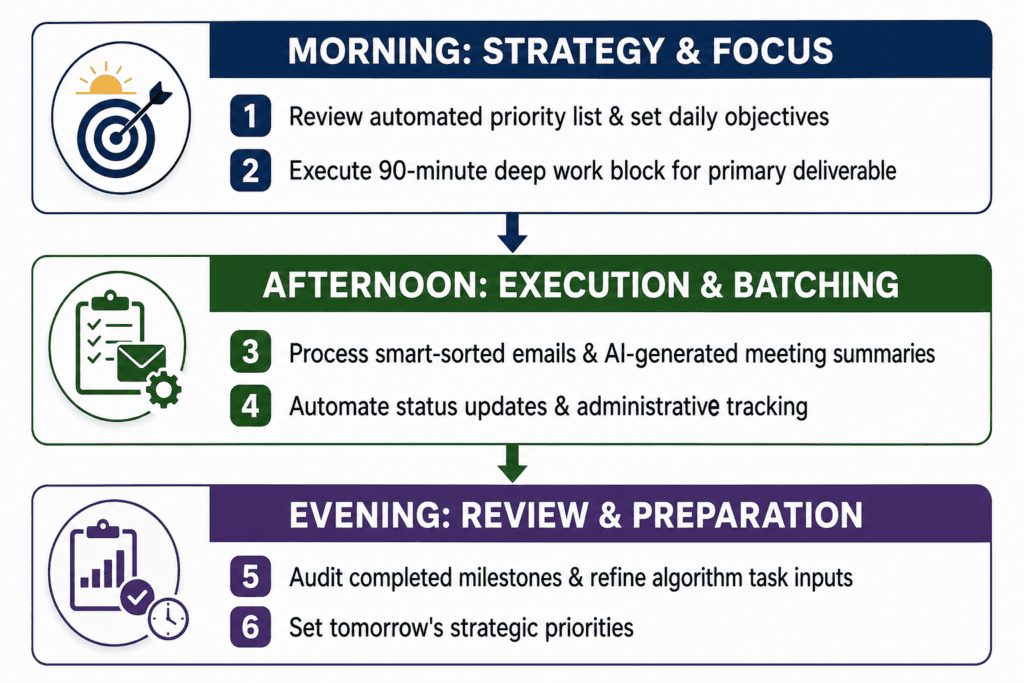
Developing a seamless daily flow requires consistent practice. Utilizing smart platforms to handle scheduling, data organizing, and meeting transcriptions ensures that your calendar remains balanced and focused on core objectives.
The Human Side of AI-Powered Time Management
While automated tools offer remarkable speed, they cannot replace core human skills. Technology acts as an efficiency engine, but human vision provides direction and purpose. Successful implementation of Time Management in the Age of AI relies on combining automated speed with human intuition.
Critical thinking, empathy, creative problem-solving, and relationship-building remain uniquely human strengths. An automated tool can generate a data report in seconds, but interpreting what those numbers mean for a client relationship requires human leadership. Sanjeev Bhutani reinforces the idea that technology serves to free up human capacity, enabling teams to build stronger relationships and explore creative avenues that software cannot replicate.
Common Mistakes to Avoid When Using AI for Time Management
Adopting digital workflows without a clear plan can lead to unexpected productivity traps. Avoiding common missteps ensures that tech stack investments yield genuine efficiency gains:
- Over-Automating Core Processes: Automating tasks that require nuanced human judgment can result in errors and miscommunication.
- Tool Overload: Adopting too many single-purpose applications creates fragmentation, increasing management overhead instead of reducing it.
- Uncritical Trust: Failing to review generated summaries, reports, or drafts can lead to inaccuracies in professional deliverables.
- Ignoring Data Privacy: Feeding sensitive corporate data into unverified platforms creates unnecessary security risks.
Sanjeev Bhutani cautions professionals against measuring output purely by volume. Producing lower-quality work faster is not true productivity; the goal must always remain centered on driving higher value.
Practical Tips for Better Time Management in the Age of AI
Implementing Time Management in the Age of AI does not require a complete overhaul of your current work practices overnight. Small, deliberate adjustments build sustainable habits:
- Start Small: Pick one repetitive administrative process—such as meeting transcriptions—and apply an automated solution.
- Establish Clear Boundaries: Designate specific times during the day for deep, uninterrupted work without digital notifications.
- Verify Everything: Treat generated drafts and summaries as starting points, always applying human oversight before final delivery.
- Batch Communication: Use intelligent sorting to group low-priority updates, reviewing them during dedicated check-ins rather than reacting immediately.
Building momentum with practical steps helps professionals maintain control over their schedules while continuously learning new efficiency techniques.
The Future of Work and AI-Assisted Productivity
The future workplace will rely heavily on seamless human-AI collaboration. As smart systems mature, they will become more context-aware, handling complex cross-functional workflows with minimal oversight.
Instead of managing basic schedules, future productivity platforms will help anticipate project bottlenecks, reallocate team resources dynamically, and offer real-time workload balancing. According to Sanjeev Bhutani, professionals who master Time Management in the Age of AI today will be well-positioned to lead tomorrow’s workplace. The future belongs to those who use modern tools to elevate strategic output while keeping human connection at the center of their work.
Conclusion
Mastering Time Management in the Age of AI is ultimately about redefining how we value human effort. Technology offers unprecedented opportunities to eliminate manual overhead, organize complex projects, and streamline daily routines. However, the true objective is not simply doing more work in less time; it is creating space for meaningful accomplishments, creative thinking, and a healthier work-life balance.
By incorporating intelligent tools into a structured routine—while maintaining human intuition, critical thinking, and ethical boundaries—professionals can achieve sustained productivity. As Sanjeev Bhutani emphasizes, working smarter means letting technology handle routine execution, freeing humans to lead with strategy, creativity, and purpose.
Frequently Asked Questions (FAQs)
Q1: What does Time Management in the Age of AI actually mean?
It refers to using artificial intelligence tools to handle routine planning, task sorting, scheduling, and administrative work. Instead of relying purely on manual calendars and willpower, AI-driven time management automates low-value activities so you can spend your time on high-impact strategic work.
Q2: Will using AI for time management reduce the quality of my output?
No, as long as you use AI as an assistant rather than a replacement for human judgment. AI handles data sorting, drafting, and scheduling, while you provide the critical thinking, creativity, and final oversight necessary to maintain high standards.
Q3: How do I choose the right AI productivity tools without getting overwhelmed?
Start small with a single focus area, such as calendar management or meeting transcriptions. Avoid introducing multiple new apps at once. Pick one tool that solves a clear bottleneck, integrate it into your routine, and evaluate its impact before adding more software.
Q4: Can small businesses or solo professionals benefit from AI time management?
Yes. Solo professionals and small teams often see the largest efficiency gains because AI fills administrative gaps that would otherwise require dedicated support staff, allowing individuals to operate with the output capacity of larger teams.
Q5: How does AI help maintain a healthy work-life balance?
By taking over repetitive tasks and optimizing daily schedules, AI reduces the need to work overtime to keep up with administrative demands. It allows you to complete your core deliverables during standard working hours, protecting your personal time and preventing burnout.
