
Soft Skills Training For Corporate Employees

Best 10 Communication Skills Trainers in India
May 27, 2026
Personality Development Training For Employees
May 27, 2026Soft Skills Training for Corporate Employees: The Ultimate Guide to Modern Workplace Success
In the rapidly evolving modern business landscape, technical expertise and hard skills are no longer the sole guarantors of organizational success. While a university degree or technical certification might secure an initial job interview, it is an individual’s interpersonal capabilities that determine their long-term career trajectory and their ability to drive corporate growth. Today, organizations worldwide are recognizing that a workforce rich in empathy, adaptability, and clear communication is far more productive and resilient. This shift in corporate strategy highlights the growing necessity of comprehensive soft skills training for corporate employees.
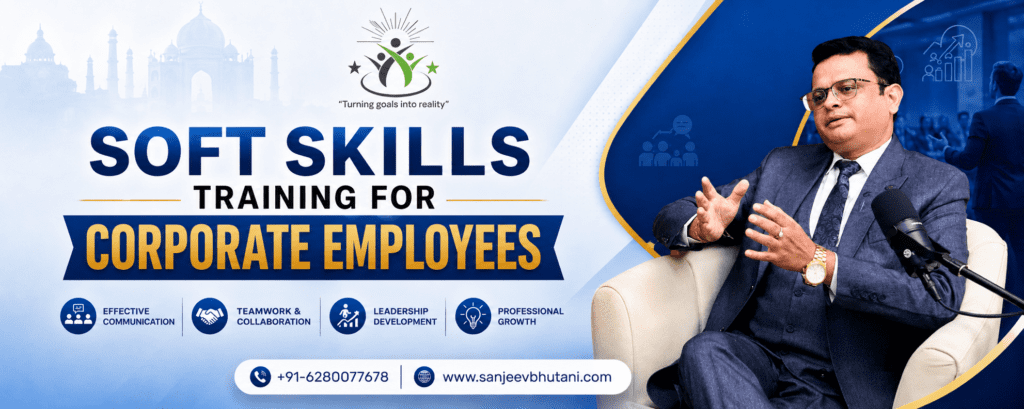
When organizations invest in professional development, they bridge the critical gap between technical execution and strategic collaboration. However, designing and delivering an impactful training program requires seasoned expertise. Renowned corporate trainer Sanjeev Bhutani has been at the forefront of this transformation, helping businesses cultivate high-performing cultures through tailored behavioral interventions. By aligning corporate behavioral skills with measurable business outcomes, customized training initiatives unlock the hidden potential within teams, turning individual contributors into visionary leaders.
Importance of Soft Skills in the Corporate World
The modern corporate ecosystem operates on collaboration, cross-functional projects, and global client interactions. Consequently, technical proficiency alone cannot sustain a company’s competitive edge if its workforce struggles with internal friction, miscommunication, or an inability to adapt to market changes. High-quality soft skills training for corporate employees acts as the baseline framework that holds an organization together, converting individual capabilities into collective, streamlined success.
Furthermore, as automation and artificial intelligence reshape daily operations, uniquely human capabilities become an organization’s most valuable assets. Traits such as critical thinking, adaptability, and cross-cultural understanding cannot be replicated by algorithms. Corporate entities that prioritize these behavioral competencies find themselves better equipped to handle market disruptions. By integrating targeted employee personality development programs, businesses create a workplace culture where innovation flourishes naturally and operational friction is drastically reduced.
Benefits of Soft Skills Training for Employees
Investing in a robust corporate training program yields significant, measurable returns for both the workforce and the management. When companies partner with specialists like Sanjeev Bhutani, they experience a noticeable shift in workplace dynamics, employee morale, and overall operational efficiency.
Enhanced Employee Engagement and Retention
When professionals feel that their employers are genuinely invested in their holistic growth, their engagement levels rise sharply. Comprehensive soft skills training for corporate employees demonstrates an organization’s commitment to long-term professional development training. This investment builds deep organizational loyalty, significantly lowering turnover rates and saving substantial recruitment costs.
Improved Customer Satisfaction and Client Relations
For client-facing teams, interpersonal capabilities directly dictate the company’s bottom line. Employees who possess strong active listening skills, empathy, and problem-solving abilities can handle client grievances smoothly and build lasting professional partnerships. Ultimately, refined workplace communication skills convert standard business transactions into enduring client relationships.
Accelerated ROI and Business Growth
A workforce that collaborates seamlessly naturally experiences fewer project delays and operational bottlenecks. Through standardized soft skills training for corporate employees, businesses optimize daily workflows, accelerate project delivery timelines, and boost overall profitability. The resulting cultural transformation creates a sustainable competitive advantage in any industry.
Communication Skills in the Workplace
Clear, precise, and empathetic communication forms the foundational cornerstone of every successful business operation. Misunderstandings, vague instructions, and poor listening habits lead to missed deadlines, damaged client relationships, and internal team conflicts. Therefore, effective workplace communication skills are vital for maintaining alignment across different tiers of management.
To address these challenges, corporate communication training programs focus heavily on breaking down information silos. Participants learn to articulate complex ideas simply, write impactful emails, and read non-verbal cues effectively. Under the guidance of expert trainers like Sanjeev Bhutani, professionals learn to master the art of the presentation and pitch. Refining these verbal and written capabilities ensures that corporate objectives are communicated transparently, maximizing execution speed across the entire firm.
Leadership and Teamwork Development
True leadership is not defined by a corporate title or an office space; it is defined by influence, inspiration, and the ability to guide others through complex challenges. As organizations flatter their hierarchies, employees at all levels must display leadership traits. Targeted soft skills training for corporate employees nurtures these exact competencies, preparing mid-level managers to confidently step into senior executive roles.
Simultaneously, teamwork is the engine that drives large-scale corporate execution. When diverse groups work together, personality clashes are inevitable. Through structured employee personality development workshops, teams learn how to leverage individual strengths while mitigating collective weaknesses. Sanjeev Bhutani specializes in designing collaborative exercises that break down defensive barriers, instill deep mutual trust, and align diverse departmental goals with the overarching corporate vision.
Time Management and Productivity
In a fast-paced corporate environment, hours are frequently wasted on low-priority tasks, unnecessary meetings, and disorganized workflows. Without structured behavioral strategies, employees easily succumb to burnout and chronic stress. Consequently, learning to manage time effectively is no longer just a personal habit—it is a critical corporate requirement.
| Productivity Matrix Element | Core Strategy | Workplace Impact |
| Ruthless Prioritization | Distinguishing urgent tasks from deeply important goals. | Eliminates wasted effort on low-value assignments. |
| Delegation Frameworks | Assigning ownership based on team strengths. | Empowers junior staff and frees executive time. |
| Boundary Setting | Managing interruptions and meeting schedules. | Protects focused, deep-work hours for innovation. |
Through dedicated professional development training, staff members learn to structure their workdays intentionally. Sanjeev Bhutani introduces practical, real-world frameworks that help professionals eliminate daily distractions and balance competing deadlines. By mastering these behavioral strategies, corporate teams achieve high-quality output without sacrificing their mental well-being or work-life balance.
Conflict Resolution and Emotional Intelligence
Wherever people work closely together, differences in opinion and friction will occur. However, unmanaged conflict rapidly degrades team morale and poisons company culture. This is where emotional intelligence (EQ)—the capacity to recognize, understand, and manage emotions—becomes an essential business tool.
Comprehensive soft skills training for corporate employees provides professionals with the specific communication tools needed to navigate sensitive discussions constructively. Instead of avoiding difficult conversations or reacting defensively, employees learn to approach friction with a calm, analytical mindset. Training sessions led by Sanjeev Bhutani focus on transforming potential workplace friction into productive brainstorming opportunities, ensuring that diverse viewpoints lead to creative business solutions rather than toxic workplace politics.
Industries That Benefit from Soft Skills Training
Every industry that relies on human interaction, strategic decision-making, and collective execution requires regular behavioral interventions. The impact of customized training programs spans across multiple diverse sectors:
- Information Technology (IT) & Software: Helps technical engineers, developers, and data scientists transition smoothly into client-facing consulting roles and leadership positions.
- Pharmaceuticals & Healthcare: Equips medical representatives, corporate teams, and research managers with the high-impact negotiation and empathetic communication skills required for highly regulated markets.
- Hospitality & Tourism: Refines frontline service etiquette, emotional resilience, and crisis-management capabilities to deliver world-class guest experiences.
- Banking, Financial Services, & Insurance (BFSI): Empowers financial advisors and relationship managers to build deep, long-term trust with high-net-worth clients.
- Education & EdTech: Assists academic leaders, administrative heads, and corporate counselors in communicating value effectively to students and global stakeholders alike.
Why Choose Sanjeev Bhutani for Corporate Soft Skills Training?
Selecting the right training partner is the single most important factor in ensuring the success of your professional development initiatives. A cookie-cutter approach rarely yields long-term behavioral changes. Sanjeev Bhutani brings years of corporate training experience, offering highly customized, dynamic programs engineered specifically around your organization’s unique operational needs and pain points.
The Bhutani Advantage: “True behavioral transformation requires moving past theoretical lectures. We build interactive learning journeys that shift mindsets, drive accountability, and create measurable performance improvements.”
Rather than delivering generic motivational speeches, Sanjeev Bhutani utilizes an interactive training methodology packed with live role-plays, real-world case studies, and practical behavioral frameworks. This hands-on approach ensures that your workforce absorbs these critical concepts and immediately applies them to daily corporate challenges. By aligning corporate behavioral skills with your specific business goals, he delivers sustainable, measurable performance improvements that positively impact your bottom line.
Frequently Asked Questions
1. What is the ideal duration for a corporate soft skills training program?
The duration depends entirely on your specific learning objectives. While foundational workshops can be delivered in intensive 1-2 day sessions, sustainable behavioral transformation typically requires long-term corporate communication training tracks spread out over several weeks or months.
2. How does Sanjeev Bhutani measure the ROI of soft skills training?
Sanjeev Bhutani uses a structured evaluation framework to track progress. ROI is measured by evaluating participant engagement, conducting post-training behavioral assessments, and analyzing key operational metrics such as employee retention, project delivery speeds, and customer satisfaction scores.
3. Can these behavioral training sessions be customized for specific corporate hierarchies?
Yes, absolutely. Soft skills training for corporate employees is highly tailored. Programs can be designed separately to help entry-level executives build workplace communication skills, or configured as advanced leadership development retreats for C-suite executives.
4. What is the difference between hard skills and soft skills?
Hard skills refer to the specific technical knowledge and functional expertise required to perform a job, such as coding or financial accounting. Soft skills are the core behavioral traits and interpersonal capabilities—such as emotional intelligence, teamwork, and time management—that dictate how effectively you apply that technical knowledge within a team.
5. How often should corporate employees undergo soft skills training?
Behavioral development is an ongoing journey rather than a one-time event. To keep pace with shifting market trends and evolving organizational cultures, companies should schedule professional development training sessions at least twice a year, supplemented by continuous micro-learning modules.
Conclusion
To stay ahead in a highly competitive market, businesses must realize that their long-term growth is powered entirely by their people. Technical tools provide the infrastructure, but interpersonal excellence is the fuel that drives real execution. Prioritizing soft skills training for corporate employees is a proven strategy to cultivate an agile, motivated, and future-proof workforce that handles challenges with grace and confidence.
Do not allow communication gaps, unresolved internal friction, or poor leadership habits to slow your company’s progress. Transform your corporate culture and maximize your team’s collective output with expert-led training interventions. Partner with Sanjeev Bhutani today to design a high-impact, tailored corporate training program that turns your workforce into your greatest competitive advantage.
